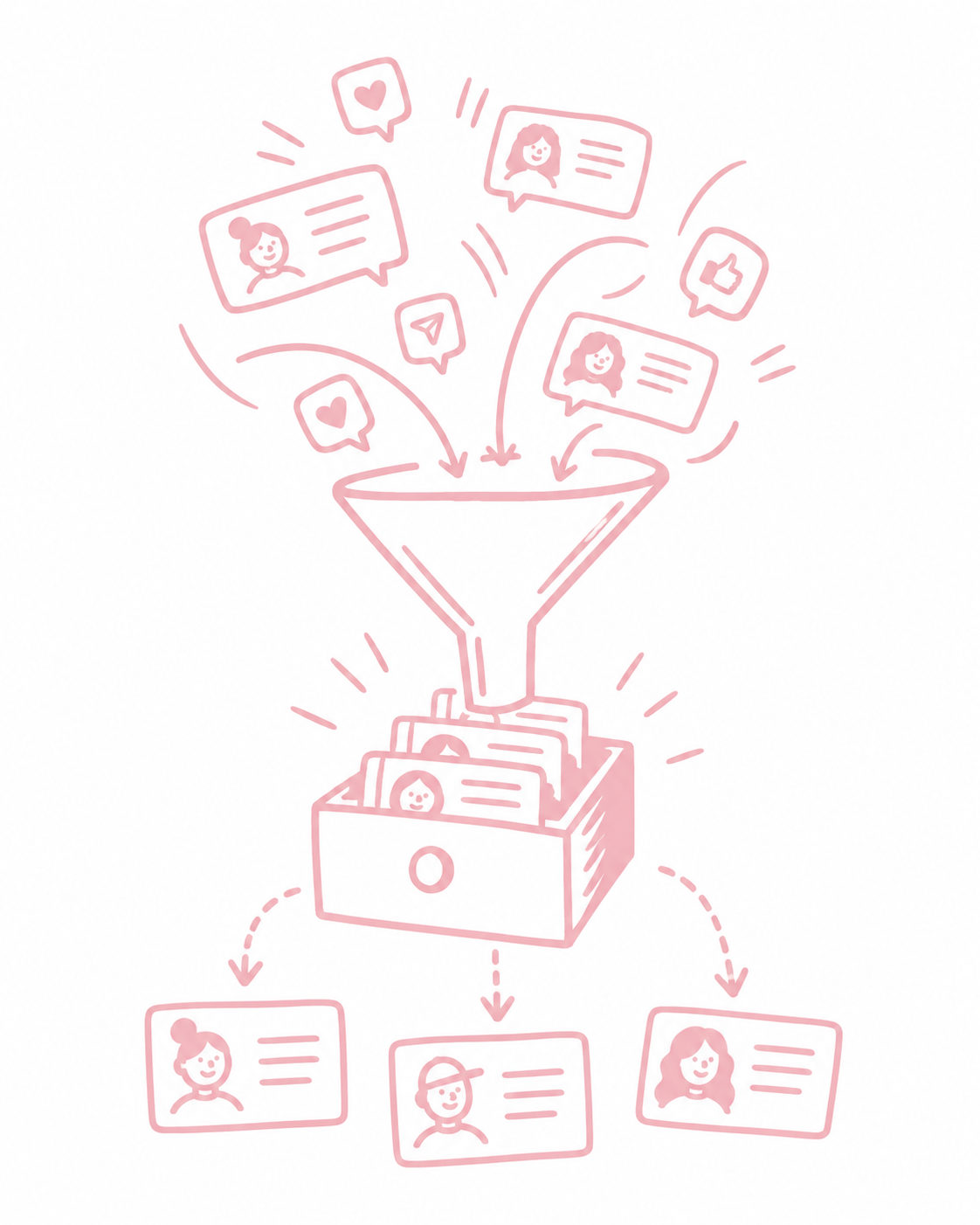
This article provides a practical framework for service providers in Germany to build a CRM for content leads. It avoids a tool-specific approach, but instead focuses on measurably increasing conversions.
Why social media lead generation without a CRM almost always costs money
Many teams collect leads in many places:
- Instagram DMs
- Website forms
- LinkedIn messages
- Phone calls
- Comment sections
The problem isn't a lack of leads. The problem is that they're scattered. This leads to typical mistakes:
- No one feels responsible
- Response times become too long
- Leads aren't qualified
- There's no follow-up, no routine
- It's impossible to evaluate which campaigns are actually working
The result: your CPL increases, your conversion rate decreases, and performance marketing appears more expensive than it needs to be.
What a CRM really contributes to the content journey
A CRM isn't just a contact list. It's the operating system for your customer journey. It connects content, ads, and sales.
A good CRM setup ensures:
- faster response time to social media inquiries
- a clear pipeline from lead to customer
- better lead quality through structured qualification
- more sales through follow-up
- better decisions because you have data instead of gut feeling
In short: A CRM is the difference between "social media sometimes works" and "social media is a predictable acquisition channel."
The simplest pipeline for content leads that almost always works
You don't need 20 stages. For service providers, 6 to 8 pipeline phases are often sufficient. Here's a proven structure that works well for lead generation from Instagram, TikTok, LinkedIn, and your website:
- New lead received
- Contact made
- Qualified or unqualified
- Appointment scheduled
- Appointment held
- Offer sent
- Won or lost
- Follow-up or Nurturing
This pipeline is simple, but it forces you to bring every request to a clear status. This reduces chaos and increases conversions.
Lead management: What data you really need per lead
Many CRMs fail because they require too many fields to be maintained. Then nobody maintains them. For social media leads, you only need a few pieces of information to start:
- Name and contact method (email, phone, DM, WhatsApp)
- Source (Instagram Reel, TikTok, LinkedIn, Meta Ads, website)
- Interest or need (briefly as a tag or note)
- Pipeline status
- Next step and date (follow-up appointment)
This data is sufficient to later analyze which platform, campaign, or content format actually generates customers. It brings.
Follow-up: Why most sales don't happen on the first contact
A large proportion of deals aren't closed during the first conversation or initial contact. Many leads are interested but not immediately ready to make a decision. If you don't follow up, you'll lose them to:
- Everyday life
- Competition
- Uncertainty
- Lack of priority
That's why you need a follow-up rhythm that isn't annoying but is consistent. Follow-up isn't spam. Follow-up is service because you're guiding people through the decision-making process.
A simple follow-up logic:
- Respond within 24 hours
- If there is no response, follow up after 2 to 3 days
- Then again after 7 days
- And then transition to a longer interval if it's not convenient right now
It's important that the follow-up is visible in the CRM. Otherwise, it won't happen reliably.
CRM and social media DMs: The critical Bottleneck
Many leads come via direct messages. That's good, but it's also risky because DMs aren't a clean lead management tool. Messages get lost, overlooked, or stuck with someone.
The solution isn't to stop using DMs. The solution is to have a process for getting DMs into the CRM so sales can work efficiently. You can start this manually and automate it later. The important thing is that it happens at all.
Qualification: How to prevent wasting time on the wrong leads
When you generate leads from social media, you need a short qualification process. Otherwise, reach leads to unproductive conversations. Qualification doesn't mean you have to be harsh with potential leads. It means you quickly clarify:
- Does this generally work?
- Is the budget realistic?
- Is the timing sensible?
- Who decides?
Many companies start qualification too late and then wonder why their sales process is inefficient. A CRM helps to capture and retrieve this information in a structured way.
Reporting: Which metrics you should really look at in your CRM
If you want to seriously manage performance marketing, social ads, and content production, you need numbers. But not 50 dashboards. A few key metrics are enough:
- Response time to leads
- Appointment rate (leads to appointments)
- Show-up rate (appointments attended)
- Conversion rate (appointments to customers)
- Time to conversion
- Source of acquired customers
Knowing these metrics allows you to optimize your content strategy, video marketing formats, and ads much more precisely. And you'll quickly see whether the problem is really the lead costs or whether it's a problem in the process.
Tool question: Which CRM is the right one?
The tool question is important, but it's not the starting point. The starting point is always the pipeline and process. Nevertheless, a realistic overview is provided.
For many small and medium-sized enterprises, a CRM that can:
- map a pipeline is sufficient
- Manages tasks and follow-ups
- Tracks sources
- Keeps notes and tags organized
- Integrates with email or calendar
Whether it ends up being HubSpot, Pipedrive, Zoho, Salesforce, or another tool depends on your team, your sales process, and your budget. The important thing is that you use it, not the name.
Conclusion: CRM makes social media marketing predictable
Content marketing and video marketing deliver visibility. Performance marketing and social ads deliver speed. But a CRM transforms them into a system that truly converts.
If you regularly receive social media inquiries, but the results are inconsistent, a CRM is almost always the next logical step. Not as an administrative project, but as a conversion driver.
With a clear pipeline, fast response times, consistent follow-up, and clean tracking, social media leads are converted into appointments and sales much more frequently.
FAQ: CRM and lead management for social media leads
Why do I need a CRM for Instagram leads?
Because Instagram DMs are not a reliable lead management tool. A CRM ensures that inquiries are tracked and don't get lost.
What is the most important CRM metric for service providers?
Often it's response time and appointment rate. If you improve in these areas, conversions usually increase immediately.
How quickly should you respond to social media inquiries?
As quickly as possible. Ideally within 24 hours, otherwise the chance of securing an appointment drops significantly.
Do I need a CRM even without ads?
Yes. Organic leads also need follow-up and structure. A CRM makes organic lead generation more efficient.
What is the difference between lead management and CRM?
Lead management is the process; CRM is the system that maps the process. Without a process, the tool is of little use.
How do I prevent leads from getting stuck within the team?
With clear responsibilities, a pipeline, follow-up tasks, and a standardized process for how leads get into the CRM.
Can DMs be automatically transferred to the CRM?
Yes, depending on the platform and tool, this is possible. However, many people prefer to start manually and automate later.
How is CRM related to conversion rate and CPL?
When CRM and follow-up improve, the conversion rate increases. This makes each lead more valuable and automatically reduces the CPL.
What Vertikal Viral Can Deliver
We don't just produce content and implement social media marketing; we consider the entire journey to conversion. This means we work with you to build a clear social media customer journey, develop content formats for lead generation, produce the videos, and ensure that no leads are lost. This includes processes for direct messages, clear handoffs, a pipeline structure, and, upon request, the right assets for landing pages, retargeting, and performance marketing, so that social media is not only visible but also measurably generates inquiries and appointments.
The handover with a real test case Check
Defines a clear starting point for a new inquiry: When is it considered received, who takes it on, and what next action is documented? A status like "in progress" isn't sufficient if no one knows whether a response has been received or if information is still missing.
A possible acceptance test is to send a request, explicitly marked as a test, through each important enquiry channel. This checks whether the contact is created once, whether the origin is retained, and whether a responsible person sees the task. Repeat the test with a previously known email address to prevent duplicates from inadvertently skewing the results.
Only captures information that you actually need and can legally process. Free text from private messages does not automatically belong in every connected tool. Define access, retention, and deletion with the responsible parties.
For ongoing improvement, reasons for unsuitable requests are helpful: incorrect need, unsuitable scope, or unclear timing. Such feedback can be directly incorporated into the next ad. The connection describes Performance Creative. When messages are automatically categorized, a traceable handover to humans is also necessary. Handover to people.