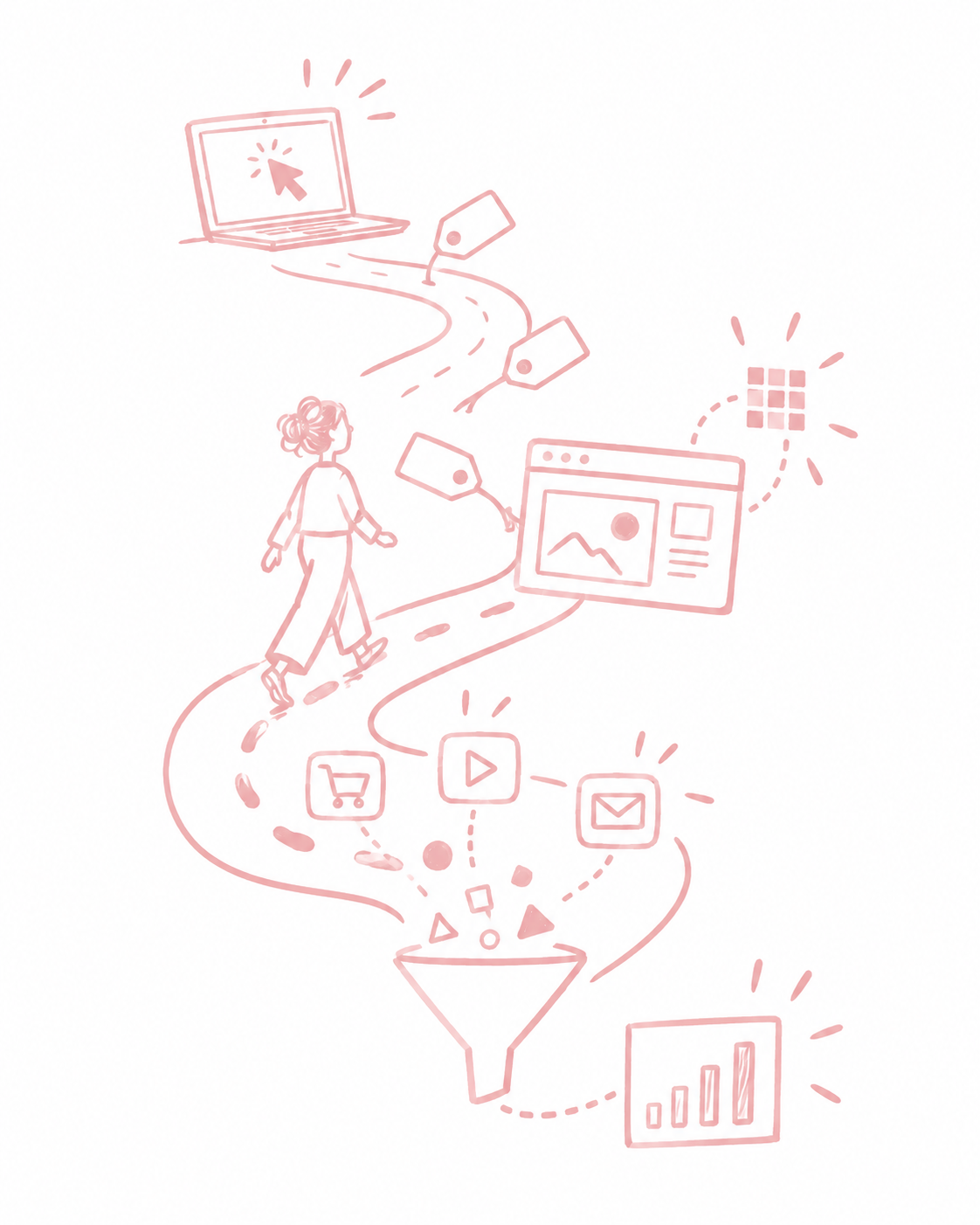
This mini-guide explains in practical terms what UTMs, pixels, and events are, how they are used in everyday practice, and what minimum setup you need to make social media marketing and performance marketing measurable.
Why this setup is so effective
Measurability isn't just reporting. Measurability is control. If you don't know which channel generates which leads, you can't budget effectively. If you don't know which landing page converts, you're optimizing in the wrong place. If you don't know which creatives generate inquiries, you're producing content without direction.
UTMs, pixels, and events are the foundation for answering precisely these questions. Not in minute detail, but solid enough to make campaigns scalable.
UTM parameters as link logic that instantly creates clarity
UTM parameters are small pieces of additional information that you attach to a link. This allows your analytics tool to later see not only Instagram, but also whether the click came from an organic post, an ad, or a specific campaign.
Practical example: You post a Reel for Content Day and simultaneously run a recruiting ad. Without UTMs, both clicks often end up in the same category. UTM links allow you to separate content cleanly later.
This is what a UTM link looks like
A normal link:
yourwebsite.de/offer
A UTM link:
yourwebsite.de/offer?utm_source=instagram&utm_medium=organic&utm_campaign=contentday
You don't need to remember this. The important thing is that you always use three fields the same way.
What do the most important UTM fields mean?
utm_source is the platform or source. Examples: Instagram, TikTok, LinkedIn, Google, newsletter
utm_medium is the traffic type. Examples: organic, paid, referral, email
utm_campaign is the campaign or topic. Examples: recruiting_q1, contentday, leadmagnet, webinar
Optional, if you are testing variations:
utm_content is the creative variation. Examples: hook_a, hook_b, video_03
When you should use UTMs in everyday life
When you include a link in your bio and change it regularly
When you use links in Stories or Highlights
When you post articles with links on LinkedIn
When you use newsletters or email signatures
When you run ads and keep campaigns separate Want
The greatest impact comes not from perfection, but from consistency. A simple standard that everyone uses is sufficient.
Pixels as the basis for retargeting and performance optimization
A pixel is a tracking component used by advertising platforms, such as the Meta Pixel or LinkedIn Insight Tag. It sits on your website and recognizes who has visited it and what happened. This allows advertising platforms to create target audiences, for example, everyone who has visited a landing page or everyone who has started an application.
Practical example: Someone sees your Reel, clicks on the website, reads briefly, and leaves. Without a pixel, this person is gone for you. With a pixel, you can reach them again later, for example, with a second video that addresses objections. This is exactly how retargeting works.
Pixels are also important because they allow advertising platforms to learn which clicks later led to actual actions. Without pixels, many campaigns optimize for superficial signals like clicks.
In Germany, this all hinges on a proper consent setup. The logic remains the same, though: If you want retargeting and performance optimization, you need a foundation that makes it possible in the first place.
Events as measurement points for leads, appointments, and applications
The most common mistake in tracking is measuring the wrong things. Pageviews aren't leads. Clicks aren't applications. Visiting the contact page is rarely the moment that counts.
Events are clear metrics on your website. They indicate: This action has occurred.
Practical examples of events:
A lead event fires when a form is actually submitted.
An appointment event fires when a booking is confirmed.
An application event fires when an application is submitted.
A contact event can fire when someone clicks on phone, WhatsApp, or email, if that's relevant for you.
If you have these events properly defined, you can control campaigns much more effectively because you can track real results. Optimize, not on intermediate clicks.
The 30-minute checklist you need to create once
You don't have to implement it yourself. But you should define the logic so your team or service provider doesn't have to guess.
1) Define what constitutes a conversion for you.
Lead, appointment, application. Two to three goals are sufficient.
2) Define a UTM standard.
Source, medium, campaign. Consistent across all.
3) Define the mandatory events
At least one lead event. This includes appointments or applications, depending on what matters to you.
4) Clarify which platforms need to be measured
Meta, Google, LinkedIn. Only those platforms where budget is being spent.
5) Do a reality check
Can you say in two weeks whether an additional €1000 spent on ads actually generated more leads? If not, you lack measurability.
Typical mistakes that render numbers worthless
UTMs are used intermittently, making data incomparable.
Campaign names constantly change, creating chaos.
Events fire too early, for example, on the click instead of the actual conversion.
Pixels are duplicated, resulting in inaccurate numbers.
Too many things are being measured instead of accurately measuring the most important ones.
If you only want one rule: Better a few signals accurately than many signals incompletely.
Why this is also important for SEO and content systems is
UTMs, pixels, and events aren't just for ads. Once you're systematically managing content, you want to know which topics are truly effective. Which reels generate real clicks? Which blog articles generate leads? Which landing pages convert?
Measurability makes SEO and content systems manageable. Without measurability, you're left with only intuition, and intuition doesn't scale well.
Conclusion: Measurable marketing doesn't need perfection, but standards
If you want to grow organically while simultaneously engaging in performance marketing, you need a measurement foundation. A UTM standard, clean pixel implementation, and a few well-defined events are the basics.
This isn't a techie topic. This is a decision-maker topic. Once the logic is in place, implementation can happen quickly. And after that, testing, budget decisions, and content production become significantly easier.
FAQ: UTM, Pixels, Events
Are UTMs needed for organic posts?
Yes, because otherwise you can't clearly distinguish which channel is responsible for what.
What's more important, pixels or UTMs?
UTMs help with source logic.
Which events are mandatory?
Lead, appointment, or application. In other words, actions that have real business value.
Can this even be used properly in Germany?
Yes, but consent and a clean setup are important. The crucial thing is that the logic is sound and the implementation is correct.
How quickly can you see results?
As soon as a standard is used, data becomes more comparable. This is often visible after just a few weeks.
A concrete measurement plan for an inquiry
First, define the event: A request is counted after successful submission, not simply when the submit button is clicked. Otherwise, failed attempts may appear as results. A subsequent click or a page reload should not inadvertently count the same request multiple times.
For campaign links, consistent naming of source, medium, and campaign can be helpful. Google describes the parameters and their usage in the Analytics Help for Campaign URLs. Maintain consistent capitalization and names, and do not include names, email addresses, or other personally identifiable information in such links.
Next, test the entire process: open the link, check the consent status, fill out the form, see the confirmation, and verify receipt. Note which systems should see which events. A test without clear expectations only shows that data is arriving somewhere.
The 30 minutes mentioned in the title are a guideline for initial planning, not a guarantee of a fully tested technical setup. Multiple domains, external booking tools, or existing errors may require significantly more coordination. For unclear results, systematic campaign diagnostics can help..